Self-hosting
Xiaomi Miloco: Genuinely Local, Genuinely Good — and Not Actually Open Source
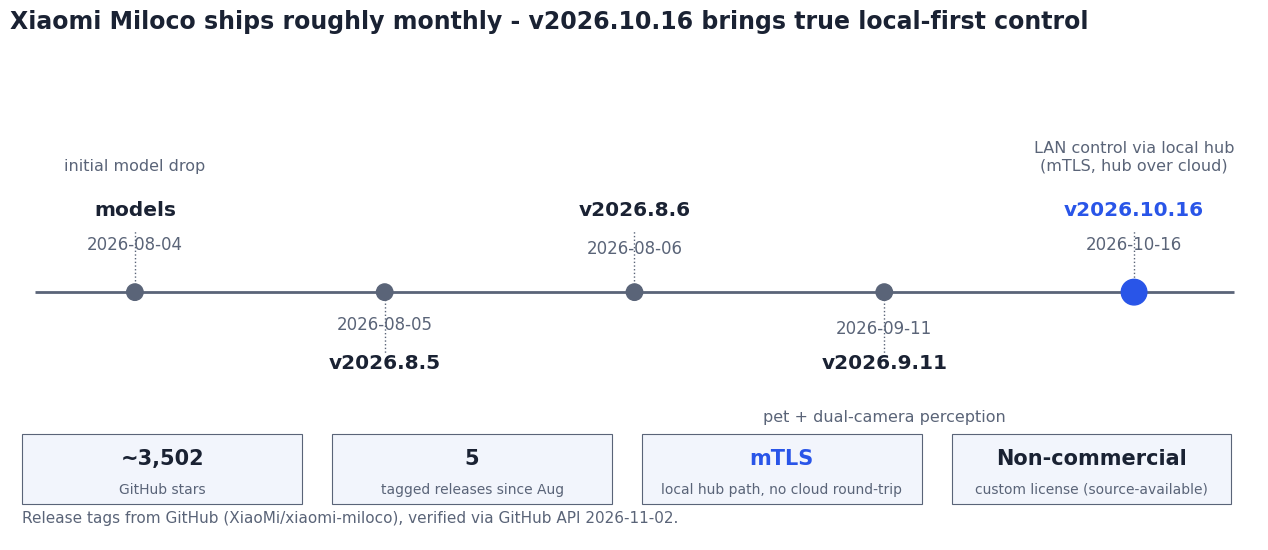
Verdict: Xiaomi's Miloco is an open-source (well — source-available, more on that below) whole-home AI brain that turns Mi Home camera video and audio into a perception layer, runs Xiaomi's in-house MiMo model as the decision core, and drives your devices through an agent plugin on top of OpenClaw. The repo (XiaoMi/xiaomi-miloco) has 3,500+ stars and ships monthly; the current release, v2026.10.16, quietly shipped the most interesting feature of the whole project: LAN control through a local central hub over a low-latency mTLS path that prefers the hub over the cloud. My call for self-hosters: if your cameras are Mi Home devices, this is the most complete local-first home AI you can run today — the LAN path, per-camera perception toggles, and rule engine are genuinely good engineering. If you are a Home Assistant household with a mixed-brand setup, the Mi Home camera lock-in is a real cost, and the license forbids commercial use and any reuse to build other software. It is not an OSI open-source license. Treat it as "free for personal use," not "open."
Verified against primary sources (2026-11-02): GitHub API for XiaoMi/xiaomi-miloco — repo created 2025-11-06, license field "Other/NOASSERTION", ~3,502 stars, latest push 2026-10-28; release v2026.10.16 published 2026-10-16; LICENSE.md full text (non-commercial, non-transferable, no sublicensing, no use to develop apps/web services); README (Mi Home cameras as full-modal perception gateway, MiMo as brain, OpenClaw agent plugin, v2026.10.16 changelog incl. local hub mTLS path and default omni model switched to mimo-v2.6-flash). Reported (transcribed): the MiMo-VL-Miloco-7B vision-language model card exists as a separate repo (~229 stars); Chinese coverage framing "MCP + Home Assistant integration" per QbitAI's contributed post (Nov 2, 2026) — I could not verify MCP/HA integration in the main README, so treat that claim as the author's framing, not verified.
Caveat (dated 2026-11-02): Star counts, release contents and license terms can change; accuracy is as of publication date.
Xiaomi open-sourced Miloco on GitHub in November 2025 and has shipped roughly monthly ever since. The current release, (published October 16, 2026), is the seventh tagged version, and the project now sits at around 3,500 stars. The pitch on the box: Mi Home cameras become a full-modal perception gateway — video and audio in — and Xiaomi's in-house MiMo model acts as the brain, running as an agent plugin on top of OpenClaw to orchestrate whole-home devices. The new default omni model in this release is mimo-v2.6-flash.
The one feature that matters: a local path that actually stays local
v2026.10.16 adds LAN control through a local central hub: a low-latency mTLS path that prefers the hub over the cloud, and works even past macOS's Local Network Privacy prompts. That single line is the difference between "local-capable" and "local-first" — most smart-home AI stacks still round-trip a cloud API for every decision. Alongside it: IoT property changes now drive rules directly from device pushes, a rule guard direction holds sibling entries until a precondition holds, and the perception runtime got a flow graph plus action-ledger entries linked to their triggering events. Earlier releases added pet recognition with a registration workflow, dual-camera multi-channel perception, and a conversational first-run setup.
Privacy control is per-camera: perception is a switch on the Overview page, and cameras left off are not analyzed at all. That is the right default direction — opt-in perception, not opt-out.
The license is the story — read it before you star the repo
The repo's license field reads "Other," and the LICENSE.md is worth reading in full. The short version: Xiaomi retains ownership of everything, current and future versions included, and grants you a personal, limited, non-exclusive, non-transferable, non-sublicensable, royalty-free license — for non-commercial use of the Miloco project only. The text explicitly says Xiaomi does not authorize using the work "to develop applications (APP), Web services, and other forms of software." You may redistribute copies, but each recipient needs the same license.
Translation for practitioners: this is a source-available project, not open source by any OSI test. You can run it at home, study it, and modify your own copy. You cannot build a product on it, and a company cannot deploy it commercially. If you were hoping to fork Miloco's rule engine into your own home-automation startup — the license forecloses that in plain language. That is not unusual for Chinese hardware vendors (and it is the same pattern we flagged on other recent "open" releases), but project READMEs in this space tend to say "open-source AI solution" and let the LICENSE.md do the quiet talking. Here it doesn't: the license is the truth, and the marketing is the framing.
Should you run it?
Two honest constraints decide this. First, ecosystem lock-in: the perception layer is built on Mi Home cameras — the whole design assumes Xiaomi hardware for eyes and ears. If you already live in the Mi Home ecosystem, Miloco gives you something Home Assistant still doesn't ship out of the box: a vision-language brain watching camera feeds and driving rules locally. If you are a mixed-brand Home Assistant household, the camera dependency is a real cost, and you should also know that the "MCP + Home Assistant integration" angle circulating in Chinese coverage comes from a contributed post, not from anything I could verify in the main README — treat it as unconfirmed. Second, deployment friction is real but bounded: there's a one-shot install script, but the knowledge base is deep (nine numbered docs), and even the README warns that WSL users need mirrored networking before camera streams will load. This is a tinkerer's project, not an appliance.
If you want my one-liner: Mi Home household, comfortable with a terminal, wants local camera intelligence — run it this weekend. Anything else — watch the project, don't marry it. The monthly release cadence since July suggests the team is shipping fast; if a genuinely open license or a HA-native path ever lands, this becomes the default recommendation.
Related reading: MiniCPM-OCR self-hosting decision, EdgeRock-4B constant-memory KV cache, Clover-35B diffusion LLM for agents, DeepSeek V4.1-Flash-1017 release notes.