AI news
structRFM Hit Nature Today — and It's Been Fully Open (MIT) the Whole Time
Short answer
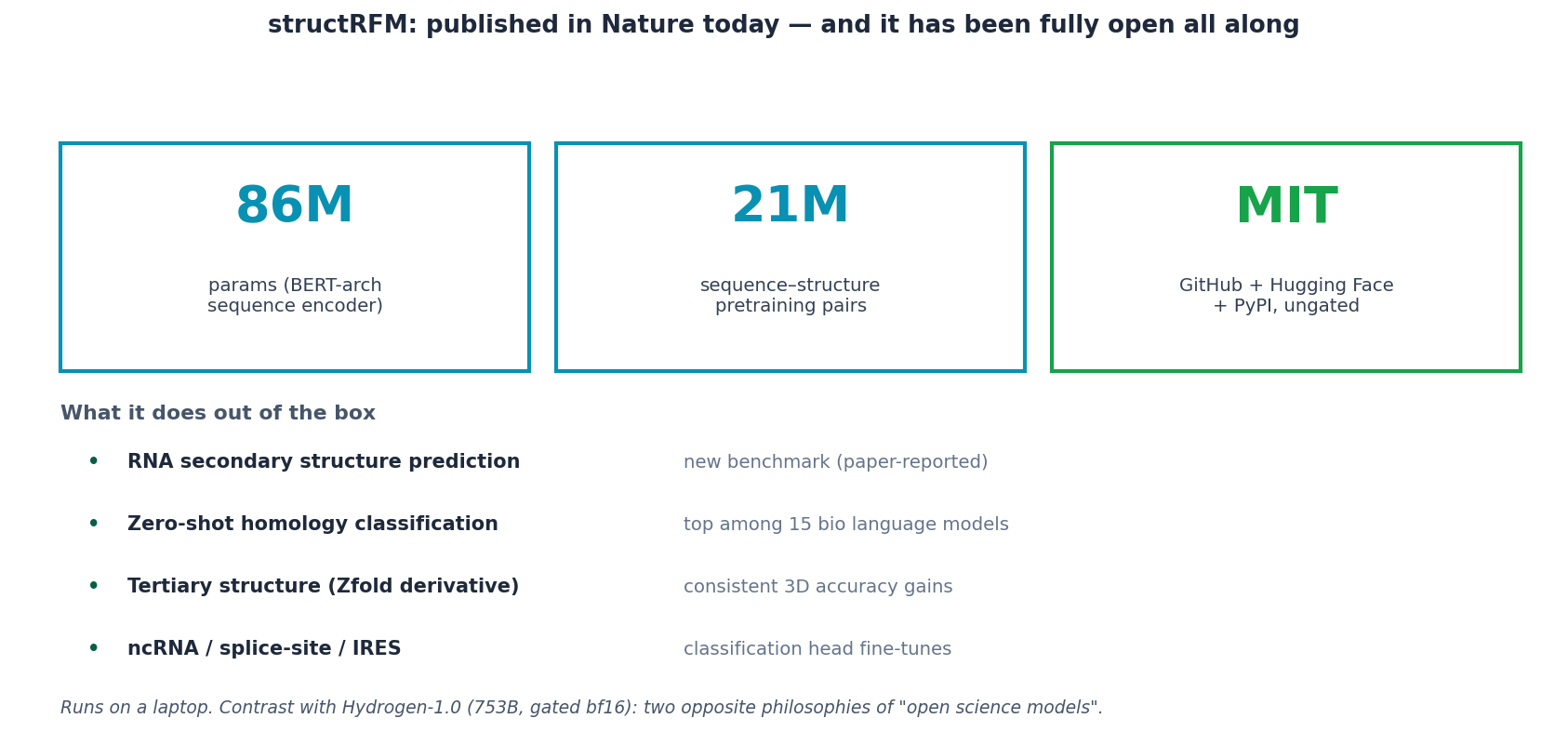
- A Chinese team's structRFM — a structure-guided RNA foundation model — was published in Nature today, and unlike most "open" AI-for-science releases, it has been fully open the entire time: MIT license on GitHub, weights on Hugging Face (ungated), and a pip package.
- Know what you're getting: this is not an LLM. It's an 86M-parameter BERT-architecture sequence encoder (we pulled the repo metadata ourselves), trained on 21M RNA sequence–structure pairs with a structure-guided masking objective. If you work on RNA secondary structure prediction, homology classification, or ncRNA/splice-site tasks, it's a new open baseline; if you want a chat model, this isn't that.
- Why it matters beyond the niche: 86M params running on a laptop vs Hydrogen-1.0's 753B gated bf16 repo — the AI-for-science field is splitting into two philosophies of "open", and structRFM is the purist end.
What the model actually is
structRFM is a BERT-style encoder with 86,052,106 parameters (per the Hugging Face safetensors metadata). The training trick is where the paper earns its Nature byline: instead of masking tokens in raw sequence space like every standard biology language model, it integrates base-pairing interactions into the masked language modeling objective — a structure-guided masking scheme with a dynamic masking ratio balancing structural and nucleotide-level masks. Pretraining consumed 21 million RNA sequence–structure pairs.
The outputs are versatile in the way encoder models are: classification-level embeddings for tasks like ncRNA classification, sequence-level embeddings for functional inference, and pair-wise matrix features that feed structure prediction. The team also derived Zfold from it for tertiary (3D) structure prediction, reporting consistent improvements over prior approaches.
The openness receipt
Every artifact is public and has been for months: GitHub (MIT), Hugging Face weights (ungated), PyPI package. The GitHub topics tell you the task surface: RNA structure prediction, ncRNA classification, splice-site prediction, IRES identification, zero-shot inference. Download counts remain tiny (51 on HF at check time) — which is exactly why English-language coverage is essentially nonexistent despite the Nature stamp.
How we'd place it
For computational RNA biology labs, this is a straightforward upgrade candidate: SOTA-reported secondary structure benchmarks, competitive zero-shot homology among 15 biological language models, and a license that never asks you anything. It won't replace RNA-FM for every workflow, and 52 GitHub stars means your risk is ecosystem maturity, not model validity — the Nature peer review is the external audit here.
Repo facts (86M params, MIT, ungated, download counts) verified against the Hugging Face and GitHub APIs on 2026-11-05; training data scale (21M pairs), masking method, and all benchmark/accuracy claims are per the Nature paper and team materials — peer-reviewed but not reproduced by us. The Nature article (s41586-026-11210-2) went live ~14 hours before this post.
Sources: Nature — An open structure-guided RNA foundation model (s41586-026-11210-2), GitHub — heqin-zhu/structRFM (MIT, checked 2026-11-05), Hugging Face — heqin-zhu/structRFM weights, CCTV/新华社 — USTC team's RNA model published in Nature