Comparisons
Step 5 Preview: The 600B Model Running on 27B — and What Its Price Hike Costs
Short answer
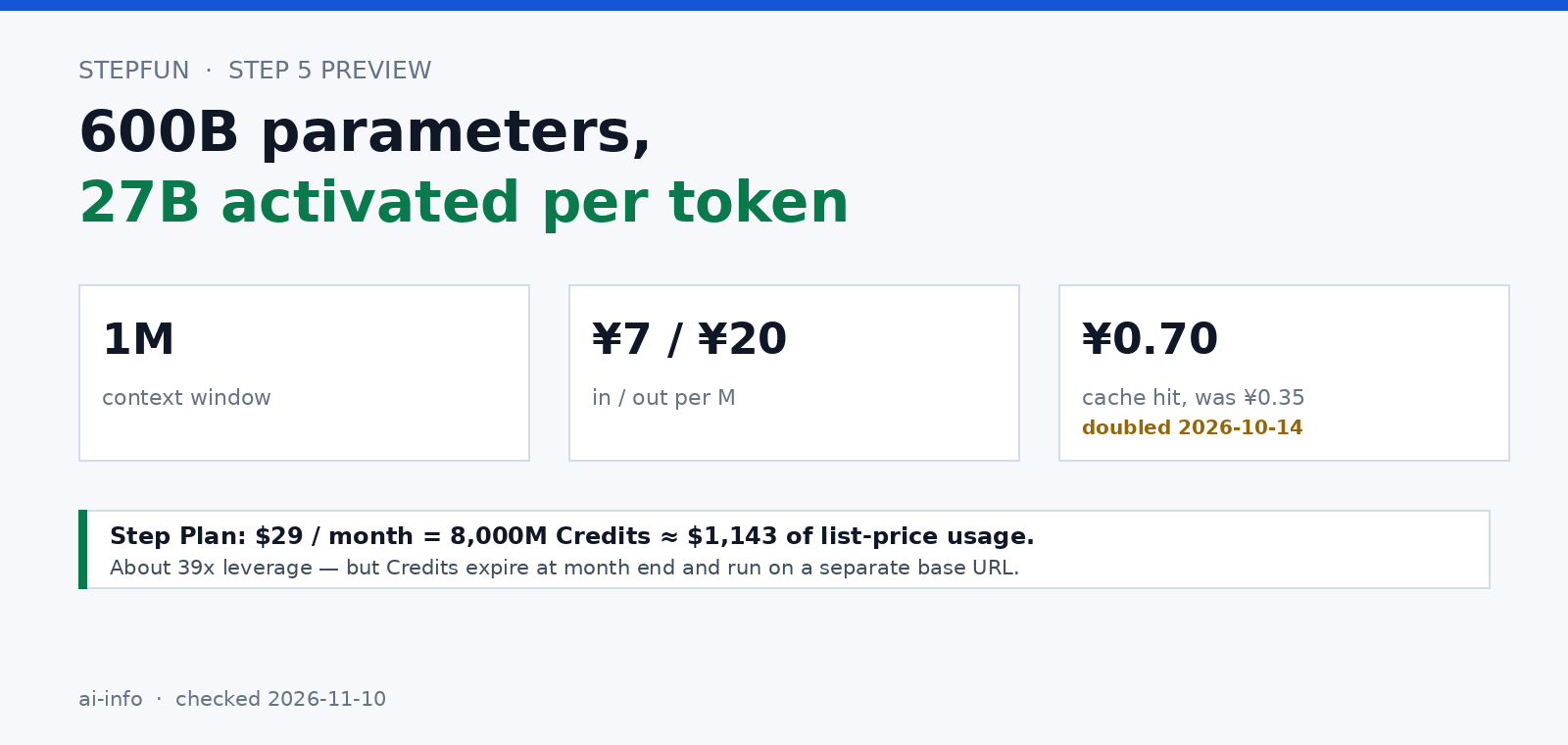
- 600B total, 27B active, 1M context — Step 5 Preview spends its parameters on capacity, not on per-token compute.
- ¥7 in / ¥0.70 cached / ¥20 out per million tokens, or $1.00 / $0.10 / $2.70 internationally. The weights were released on October 15.
- The cache-hit price doubled on October 14, from ¥0.35 to ¥0.70. Prefix-heavy workloads now pay about 31% more input than a week earlier.
- The subscription is the real discount: $29/month buys 8,000M Credits, roughly $1,143 of list-price usage — about 39x.
StepFun is the quiet one in the Chinese open-weight race: no trillion-parameter flex, no benchmark war. Step 5 Preview is a 600-billion-parameter sparse model that activates 27 billion per token, and it is priced like a mid-tier API while being marketed as a top-three open model. Both halves of that sentence deserve checking — and one of them changed on October 14.
The efficiency claim, in numbers
The architecture is the argument. A 600B total parameter base that activates 27B per token is a 22:1 ratio; for comparison, a 309B model activating 15B is roughly 20:1. StepFun's pitch is that this lands it on a new "Pareto frontier" — same intelligence for less compute per token.
The published results: an Artificial Analysis Intelligence Index score of 44, which StepFun describes as top-three among open models; a software-engineering score of 67.7, behind only GPT-6 Astra and Claude Opus 5; a 66.4 on FrontierFinance, second globally and ahead of GPT-6 Astra among open entries. On Agents' Last Exam's CLI subset and the DRACO deep-research benchmark, StepFun places it behind those two flagships but ahead of every other open model it entered against.
The cost claim attached to that is specific enough to test: StepFun says one intelligence-index task costs about $0.71, roughly one-eighth of Claude Opus 5's per-task cost. That is the number to hold them to, not "top three".
What a token actually costs
StepFun prices the same model in two currencies with a deliberate gap, and the domestic card is the one to look at if you are billing in RMB.
| Line item | China (CNY / M) | International (USD / M) |
|---|---|---|
| Input, cache miss | 7.00 | 1.00 |
| Input, cache hit | 0.70 | 0.10 |
| Output | 20.00 | 2.70 |
At ¥7/¥20 the model sits well below most flagship agent models per token while carrying a 1M context window and native image and video input. That is the honest floor of this offer: it is cheap for what it is, and the 27B activation is why.
The cache price doubled on October 14
This is the change I would want a reader to know before they build on it. StepFun's own pricing page states that the cache-hit input price for Step 5 Preview rose from ¥0.35 to ¥0.70 per million tokens at 00:30 Beijing time on October 14, 2026, with one carve-out: users who had already called the model through the pay-as-you-go API before that timestamp keep the old ¥0.35 rate.
The effect is not subtle if your prompts are prefix-heavy. Take a workload that is 90% cached input and 10% fresh: at the old rate the blended input cost was ¥1.015 per million tokens (0.9 × 0.35 + 0.1 × 7); at the new rate it is ¥1.33 (0.9 × 0.70 + 0.1 × 7). That is a 31% increase in input spend for the same traffic, on a model whose marketing is about cost efficiency.
The caching discount still exists — a hit is 10x cheaper than a miss — but it used to be 20x. If your economics depended on the old ratio, they no longer do.
The subscription is where the real discount lives
Step Plan bills in Credits rather than tokens, at a fixed conversion: about $1 ≈ 7M Credits. Because Step 5 Preview is on the supported-model list, the headline rate card is not what a subscriber actually pays. Reading the four tiers against that conversion:
| Tier | Monthly | Credits / month | List-price value | Leverage |
|---|---|---|---|---|
| Flash Mini | $6.99 | 400M | ≈ $57 | 8x |
| Flash Plus | $9.99 | 1,600M | ≈ $229 | 23x |
| Flash Pro | $29 | 8,000M | ≈ $1,143 | 39x |
| Flash Max | $99 | 40,000M | ≈ $5,714 | 58x |
Annual pricing stretches that further: Flash Max at $989 a year delivers 480,000M Credits, about $68,571 of list-price usage, a 69x multiple. Two constraints come with it, and both are real. Credits are issued once a month and expire at month end — they do not roll over. And Step Plan runs on its own base URL, separate from the standard API channel, so a subscription does not silently discount your production traffic; it is a different endpoint, and the two quotas do not touch.
Three caveats before you migrate
It is still a preview. The model is labelled Preview despite shipping weights on October 15, and preview labels in this market have historically preceded both price changes and capability changes on the same model name.
The default rate limit is low. At the entry tier — under $15 cumulative top-up — the platform grants 5 concurrency, 100 RPM and 500K TPM. That is a development ceiling, not a production one; V4 requires $1,500 topped up for 130 concurrency.
Third-party routing is not neutral. On OpenRouter the model is served by three providers, and over a recent three-day window the model's availability there was 56.65% while aggregate provider uptime read 100%. One listed provider's uptime was under 10%. If you consume this model through a router rather than StepFun directly, pin your providers and watch for failover before you attribute a failure to the model.
Sources: StepFun pricing page (zh) — ¥7 / ¥0.70 / ¥20 rates and the October 14 cache-hit adjustment with the grandfathering carve-out (checked 2026-11-10); StepFun pricing page (en) — $1.00 / $0.10 / $2.70 rates and tiered RPM/TPM table (checked 2026-11-10); StepFun Step Plan overview — $1 ≈ 7M Credits conversion, four tiers, monthly expiry, separate base URL (checked 2026-11-10); StepFun newsroom post for Step 5 Preview, 2026-09-20 — 600B/27B, 1M context, AA index 44, $0.71 per task, one-eighth of Opus 5, weights promised for October 15 (checked 2026-11-10); People's Daily Shanghai report, 2026-09-21 — software-engineering 67.7, FrontierFinance 66.4, 33 languages and 553 repositories in the internal code bench (checked 2026-11-10); OpenRouter model page for stepfun/step-5-preview — release date October 8, 2026, three providers, 56.65% three-day availability (checked 2026-11-10). Blended-cost and leverage figures above are our arithmetic on the published rates.