Self-hosting
MNN-Pocket-0.3B: Taobao's 173MB Phone Model Beats Qwen3-0.6B on Speed, Memory, and Size
Short answer
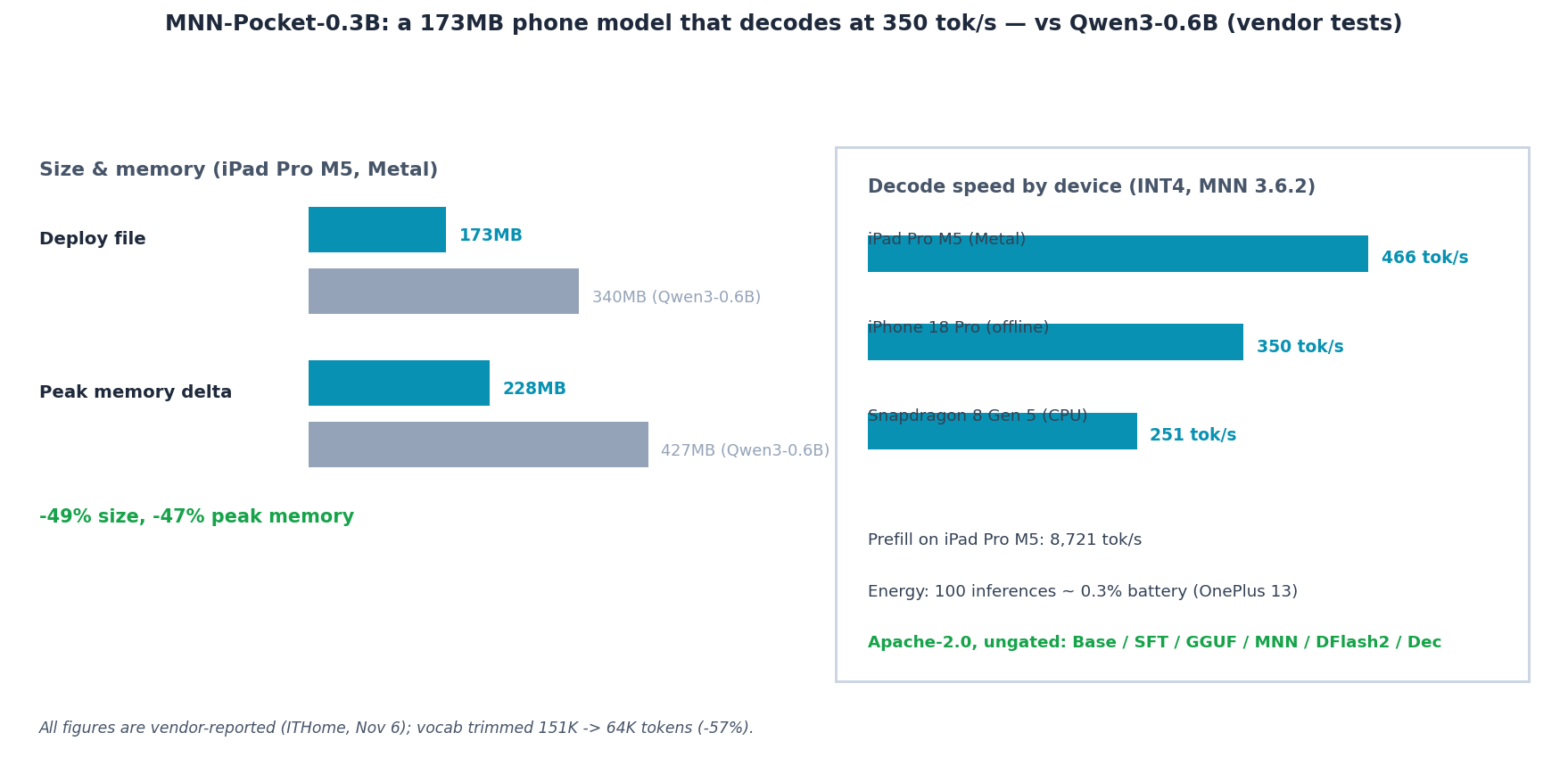
- Taobao's MNN team open-sourced MNN-Pocket-0.3B, a from-scratch ~300M-parameter model built for one job: living inside a phone app without the phone noticing. Vendor tests put it at 350 tok/s decode, fully offline, on an iPhone 18 Pro, with a 173MB INT4 deployment file and peak memory of +228MB over baseline.
- The comparison that matters: against Qwen3-0.6B on the same iPad Pro M5/Metal setup, the deploy file is 49% smaller (173MB vs 340MB), peak memory 47% lower (228MB vs 427MB), and decode is 1.63× faster (466 vs 286 tok/s). The trick is co-design: vocab cut from 151K to 64K tokens (-57%), 28 layers with GQA, and the quantization tuned with the MNN engine rather than after the fact.
- Everything ships under Apache-2.0, ungated on Hugging Face (taobao-mnn org) — Base, SFT, GGUF, the INT4 MNN build, a DFlash2 speculative-decoding draft model, and a decision-head variant. We verified the repos today: live since late September, ungated, no license walls.
Most on-device small models are compressed generalists — take a bigger model, quantize it, accept the degradation. MNN-Pocket-0.3B went the other way: the Taobao MNN team designed and trained a ~300M-parameter model from zero around four constraints that define "app-native" inference on a phone. Decode above 200 tok/s on target devices (matching the feel of fast cloud APIs). Peak memory under 300MB, inside a ~500MB module budget that leaves room for context growth and the app's actual business — photos, video feeds, checkout flows. Incremental energy cost of one typical inference (512–1024 tokens in, 128 out) under one ten-thousandth of the battery, so 100 runs stay under 1%. And 8B-class task performance on their specified business scenarios.
The architecture search was honest about trade-offs. They tested dense configurations from 50M to 1.3B parameters: ~300M was the largest size that satisfied both the memory and speed ceilings. Going from 16 to 28 layers improved capability; pushing to 36 layers added nothing to evaluation scores while decode dropped from 355 to 323 tok/s — so 28 layers with GQA it is. The tokenizer decision is the quietly clever part: they kept the Qwen3 tokenizer but trimmed the vocab from ~151K to 64K entries, cutting embedding and output-layer cost by roughly 57%. The trade — lower tokenization efficiency for languages other than Chinese and English — is exactly right for a model that will spend its life inside Chinese super-apps, and worth knowing before you point it at German text.
Vendor-reported numbers, with the usual caveats. On an iPhone 18 Pro the model runs completely offline through the MNN engine at ~350 tok/s decode. On iPad Pro M5 with Metal: 8,721 tok/s prefill, 466 tok/s decode. On a Snapdragon 8 Gen 5 CPU backend: 251 tok/s. Energy testing on a OnePlus 13: 100 identical inference tasks consumed about 0.3% of battery. On capability, the team reports an 11-benchmark average of 50.00 — ahead of MiniCPM4-0.5B and Qwen3-0.6B despite fewer parameters — including IFEval 73.20, IFEval-zh 74.59, MGSM-zh 51.20, and HumanEval 53.66. There's also a DFlash2 draft model for speculative decoding (up to 2.06× decode in specific tasks) and a decision-head variant for candidate-selection tasks.
Who should care: developers shipping assistant-style features inside mobile apps where a 500MB model budget, no network dependency, and battery discipline are hard constraints. If you need multilingual coverage beyond zh/en, look elsewhere or retrain the tokenizer. If your use case is Chinese/English task execution on-device at cloud-like speed, this is currently the most complete open package we've seen at this size — six variants covering pretraining research (Base), post-training research (SFT), general deployment (GGUF and the INT4 MNN build), and two speed/broadcast-oriented specials.
First-hand on 2026-11-07: Hugging Face repos under the taobao-mnn org verified live and ungated (MNN-Pocket-0.3B, Base, SFT, GGUF, MNN, DFlash2, Dec; Apache-2.0 tag; 527 downloads / 25 likes on the instruct variant at check time). All performance, memory, and energy figures are vendor-reported via IT之家's coverage and related reports — not independently reproduced by us. The repos existed since late September; the Nov 6 press push is the announcement wave, not the code drop.
Sources: Hugging Face — taobao-mnn/MNN-Pocket-0.3B (verified 2026-11-07), IT之家 (2026-11-06), 驱动中国 via QQ News (2026-11-06), AIbase summary