AI news
Chinese Models Take 89% of Enterprise Open-Source Spend — but Open-Source Itself Is Only 4% of the Money
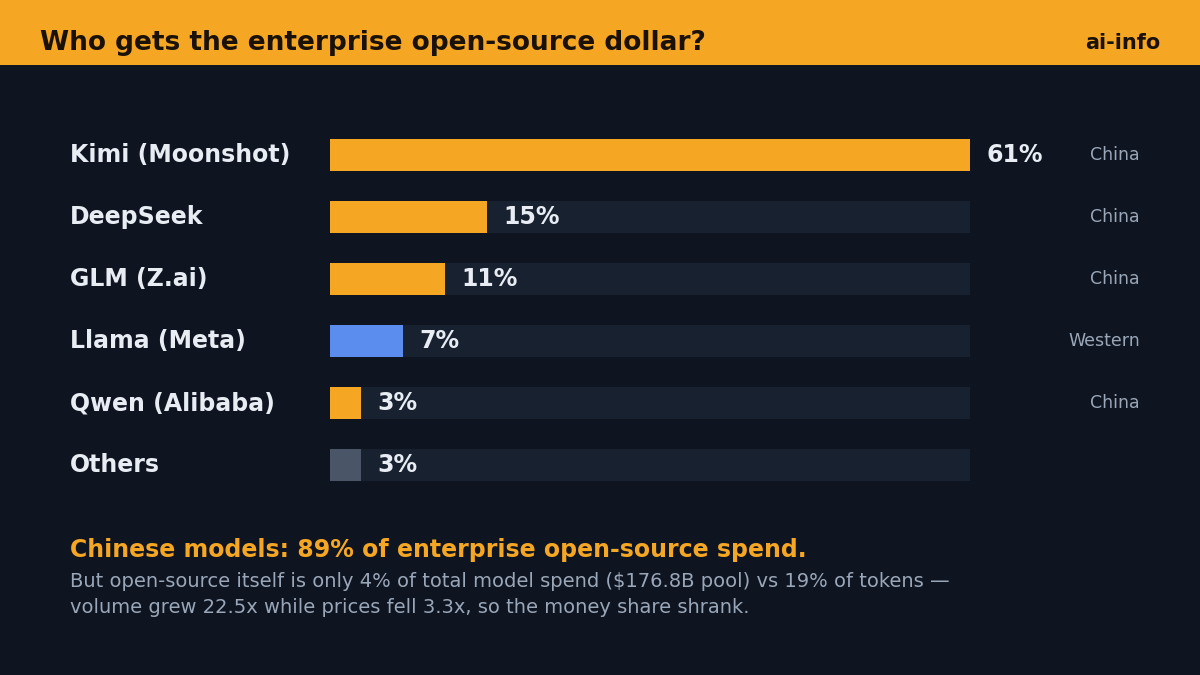
Verdict: Menlo Ventures' 2026 State of Enterprise AI report puts Chinese models at 89% of enterprise open-source spending — Kimi alone takes 61%, DeepSeek 15%, GLM 11%, while Meta's Llama leads Western models at just 7%. My read: this is a real mandate for Chinese open weights as the default self-hosting stack, but the same report shows open-source overall is still only 4% of model dollars (vs 19% of tokens) — open weights won the workload, not the wallet, and mostly their own price war did that.
The report (published early November, based on data through September 2026) sizes total enterprise AI deployment spend at $176.8B, up 5.4x year over year. Inside the open-source slice of that, the spend ranking is: Kimi (Moonshot) 61%, DeepSeek 15%, GLM (Z.ai) 11%, Llama (Meta) 7%, Qwen 3%, with everything else at 3%. That works out to roughly $4.3B going to Kimi-family open weights in enterprise deployments (my arithmetic: 4% × 89% × 61% of $176.8B — an estimate, not a Menlo figure).
The uncomfortable context: 19% of tokens, 4% of dollars
Open-source token share grew from 11% to 19%, and volume exploded 22.5x to an estimated 2.9 quadrillion tokens per month. Yet open-source spending share fell from 6% to 4%. The reason is arithmetic, not conspiracy: the average open-source token price dropped 3.3x to $0.13 per million, faster than volume grew in dollar terms, while closed-model blended pricing fell only 24% to $0.70. Open models got so cheap so fast that they shrank their own slice of the revenue pie. For buyers this is the good kind of problem; for open-model vendors it is the entire strategic question of 2027.
What enterprises still pay full price for
The same report shows frontier labs now take 69% of all deployment dollars (up from 50%), with Anthropic at 55% of enterprise LLM API spend and OpenAI at 31%. Near-frontier open models — it names Kimi K3, DeepSeek V4, and GLM-5.3 explicitly — hold under 5% of LLM API spend combined. Buyers are paying up for capability even as cheaper options exist: the most popular enterprise models moved from Claude Sonnet 4.5 ($3/$15) a year ago to Claude Opus 5.5 ($4/$20) and GPT-6 Astra ($10/$60) today.
The ecosystem pull is real, though: Menlo notes Cursor built Composer 2 on Kimi K2.5, and post-training adoption among AI builders doubled from 6% to 10% — mostly on open weights, mostly with outside inference partners like Fireworks and Modal.
What this means if you're choosing a stack
Three practical takeaways. First, the self-hosting route is no longer the budget corner — it is where 89% of open-source dollars already flow to Chinese labs, so tooling, inference partners, and fine-tuning support around Kimi/DeepSeek/GLM are the mature paths, not experiments. Second, if your workload fits an open model, the $0.13/M average open-source token price is the floor that keeps frontier vendors discounting — cache-heavy agent workloads on closed APIs (Menlo estimates ~$0.70/M blended for a typical agent session) are what you're choosing against. Third, don't read the 61% as Kimi being universally best; read it as Kimi winning the enterprise open-source wallet first. We compared Kimi K3.1 Pro's open-weights tradeoffs separately — license and self-hosting terms still matter per model.
Sources & caveats
Verified against the primary source (Nov 8, 2026): the 89%/61%/15%/11%/7%/3% splits, $176.8B total, 19%-vs-4% token/dollar shares, 22.5x volume, $0.13 vs $0.70 blended prices, 69%/55%/31% frontier shares, and the Cursor/Kimi K2.5 note are all from Menlo Ventures' published report. The ~$4.3B Kimi figure is our own derivation, flagged as such. Chinese-language coverage (IT之家, Nov 8) matches these numbers. Menlo's methodology is survey- and partner-data-based; treat shares as estimates, not census.
Dated caveat: reflects the report as published in early November 2026 and checked on Nov 8, 2026. News pages on this site are not updated after publication.