AI news
Kimi K3.1 Pro Weights Are Out: MIT-Style Terms, 1.56TB Download, and a $20M Catch for API Resellers
Short answer
- Moonshot shipped the Kimi K3.1 Pro open weights on schedule — repo
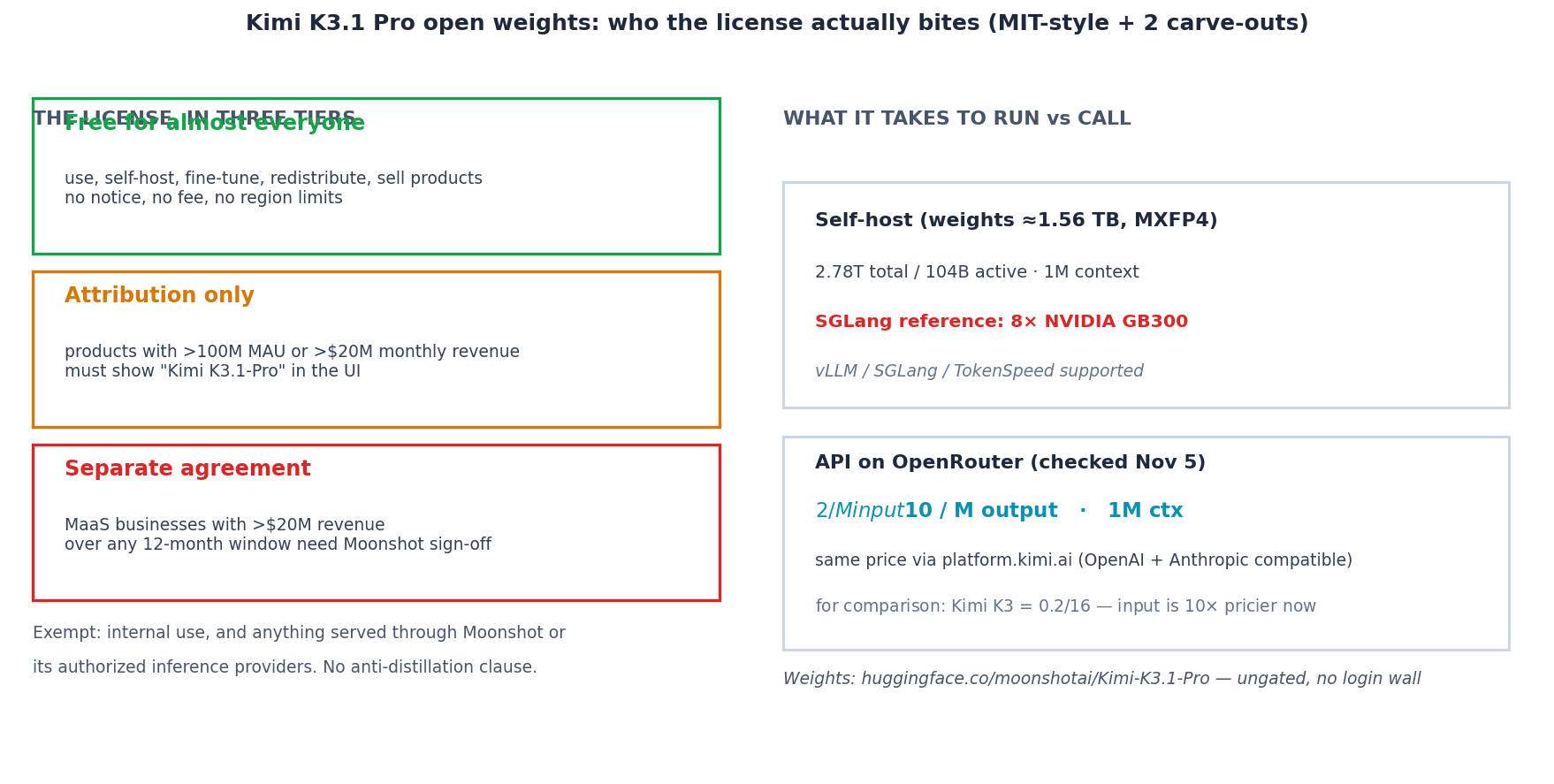
moonshotai/Kimi-K3.1-Pro, ungated, no login wall, 2.78T total params (we pulled the repo metadata ourselves). This is the first open-weights model to sit at the top of Artificial Analysis' index at 46.5, ~14 points ahead of the previous best open model DeepSeek-V4.1-Flash. - The license is MIT with exactly two carve-outs, and we read the full text: run a Model-as-a-Service business with >$20M revenue in any 12-month window → separate agreement with Moonshot; ship a product with >100M MAU or >$20M monthly revenue → display "Kimi K3.1-Pro" in your UI. Everything else — self-hosting, fine-tuning, redistribution, selling products — is free with no notice. No region restrictions, no anti-distillation clause.
- But read the hardware line before celebrating: ~1.56 TB of MXFP4 weights, SGLang's reference deployment is 8× NVIDIA GB300. For almost everyone reading this, the API at $2/$10 per M tokens (verified on OpenRouter today, 1M context) is the only realistic path. The open weights matter for the inference providers who'll drive third-party pricing down — which is the point.
What actually landed
Moonshot promised weights by Nov 4 when it announced K3.1 Pro on Oct 23, and the repo went public right on the deadline. The numbers we could verify directly from the Hugging Face API: 2,780,110,363,392 total parameters, released as MXFP4-quantized weights (the active parameters are MXFP8, quantization-aware trained), with the bulk of the tensor data packed as U8 — that's where the ~1.56 TB download size comes from. Architecture-wise it's a native multimodal MoE: 2.8T total, 104B active per token, ~1M token context.
Two details worth knowing if you're benchmark-shopping. First, K3.1 Pro swaps 24 full-attention layers for sparse attention — the same idea DeepSeek pioneered — where each token attends to only its 2,048 most relevant predecessors. That's what makes 1M context computable at all. Second, on the third-party Terminal-Bench 4.0 (agentic terminal work), it scores 63.64% — third place among 59 models, behind only Claude Opus 5.5 and Claude Sonnet 5.5, ahead of GPT-6 Astra — while averaging $4.57 per task versus Claude Opus 5.5's $13.20.
The license, in plain terms
We read the full LICENSE file so you don't have to. The body is lifted almost verbatim from MIT — free to use, copy, modify, distribute, sublicense, sell. Then two extra conditions:
Section 2 targets API resellers. If you run a "Model as a Service" business (giving third parties meaningful control over model inference or fine-tuning via API) and your group's aggregate revenue exceeds $20M over any consecutive 12 months, you need a separate agreement with Moonshot before commercial use. The definition explicitly excludes end-user products with embedded model features, and mere relaying to models hosted by others.
Section 3 targets super-apps. Products with more than 100M MAU or more than $20M monthly revenue must prominently display "Kimi K3.1-Pro" in the user interface. That's an attribution requirement, not a payment.
What's not in there matters just as much: no revenue threshold for ordinary product use, no geographic carve-outs, no clause forbidding you from training other models on its outputs. Compare that with Baidu's ERNIE 5.5 Flash Base, which landed the same day with a $50M all-commercial-use threshold, a "Powered by ERNIE" branding mandate, and EU/UK/South Korea excluded from the licensed territory — two Chinese labs, two very different philosophies of "open".
Should you self-host it?
Probably not you specifically. The weights need roughly 1.56 TB of storage, and the SGLang deployment recipe calls for eight GB300s — that's not a homelab rig, that's an inference business. One Mac Studio owner's take making the rounds: "can't wait to run it on my $23,000 Mac Studio at 0.1 tokens per second." The honest math: at $2/$10 per M tokens from Moonshot directly or via OpenRouter, you'd need extraordinary volume before owning the hardware beats renting it — and the price pressure from third-party providers now serving these very weights will only widen that gap.
Where self-hosting does make sense: you're an inference provider (under the $20M line, or with Moonshot's blessing above it), a research lab doing fine-tune work, or an enterprise with data-residency requirements that can actually staff an 8×GB300 cluster.
For everyone else, the practical takeaway is that the API just got a strong new tier: benchmark-topping agentic performance at roughly a third of Claude Opus pricing on Terminal-Bench tasks. And if your workload is input-heavy, note the flip side — K3.1 Pro's $2 input is 10× what Kimi K3 charges ($0.2), so cache-friendly long-context workloads still favor the older model.
Verdict
K3.1 Pro is the most permissively licensed frontier-grade open model you can download today, and the "open" part is real — no gating, no region blocks, MIT-grade terms for anyone under nine figures of revenue. But it's open the way a battleship is open for tours: you can look, you can even board, but only a few operators can actually take it to sea. The API is how most developers will use this model; the open weights are how the market will discipline its price.
Verified first-hand on 2026-11-05: repo metadata (2,780,110,363,392 params, ungated status, MXFP4 storage breakdown) via the Hugging Face API; the full LICENSE text quoted and paraphrased above; API pricing ($2/$10, 1M context) via the OpenRouter models API. Benchmark figures (Artificial Analysis 46.5 vs DeepSeek-V4.1-Flash 32.6; Terminal-Bench 4.0 63.64%, $4.57 vs $13.20 per task; 8×GB300 deployment reference; 1.56TB weight size; 104B active parameters) are vendor- and lab-reported as covered by PANews and Sina Tech, not independently reproduced by us.
Sources: moonshotai/Kimi-K3.1-Pro repo and LICENSE (checked 2026-11-05), OpenRouter models API (pricing, checked 2026-11-05), PANews — Moonshot open-sources K3.1 Pro weights, Sina Tech — K3.1 Pro open release details