AI news
Gemini Omni 1.2 Flash Is Live: 15-Second Video Generation, $1.5/$9 — and No Rival on OpenRouter
Short answer
- Google launched Gemini Omni 1.2 Flash today (Nov 6): its native multimodal video generation and editing model, successor to Omni 1.1 Flash — clips up to 15 seconds, better scene consistency, lower API rates, and a free tier inside Google Vids.
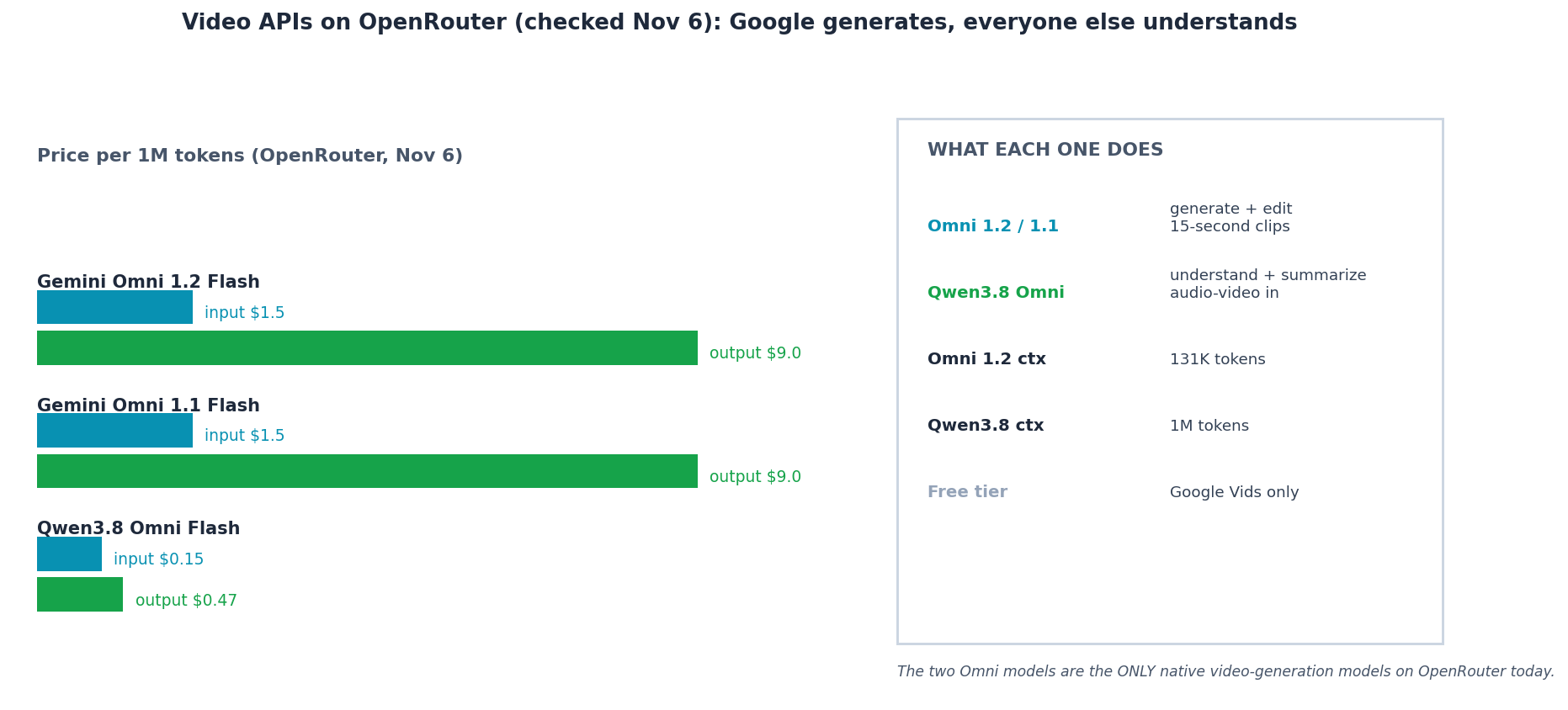
- We pulled the OpenRouter models API today: Omni 1.2 Flash is already live at $1.50 / M input, $9 / M output, 131K context — same list price as the 1.1 it replaces. And a fact nobody is leading with: the two Omni Flash models are the only native video-generation models on OpenRouter, period.
- Don't confuse it with the cheap alternative. Qwen3.8 Omni Flash costs a tenth as much ($0.15 / $0.47) with a 1M-token context — but it's an audio-video understanding model. It watches videos; it doesn't make them. For generation via API marketplace, Google currently has no competitor there.
Video generation APIs have been a mess to shop for: Veo lives in Google AI Studio, Kling and Seedance want their own consoles, open weights like Wan want your GPUs. OpenRouter was supposed to be the neutral mall — and we checked every model on it today. Exactly two can generate video natively: Gemini Omni 1.1 Flash and, as of today, its successor.
What Omni 1.2 Flash actually is
Per Google's announcement: a native multimodal video generation and editing model — you can hand it a clip and instructions, not just a prompt. The 1.2 release extends generation to 15-second clips with stronger scene consistency, cuts API rates, and ships free usage through Google Vids. On OpenRouter the per-token list price is unchanged from 1.1 ($1.50 in / $9 out), which suggests the "lower rates" either apply to Google's direct channels or to the effective cost per clip rather than per token. We can verify the OpenRouter price; the per-clip economics at Google we cannot, so treat that claim as vendor-reported.
The token math problem
Here's our honest caveat, because nobody else will give you one: we don't know how many tokens a 15-second clip costs, and OpenRouter's API doesn't expose it. Video generation billed as tokens is a black box until you run it — resolution, audio track, and edit operations all plausibly change the count. If you're budgeting, run one test clip through your account before committing. The $1.50/$9 list tells you the unit price, not the units.
Understanding is not generation
The trap today is naming. "Qwen3.8 Omni Flash" sounds like a competitor — omni-modal, $0.15/$0.47, a 1M-token context window, a tenth of the price. But read the model card: it's built for audio-video analysis and summarization. It's the cheapest way to make your pipeline watch videos and tell you what's in them — and we suspect Alibaba will keep that lane, because it's a genuinely good deal. But if you need video to come out of your API call, the Omni pair is currently the whole shelf at this particular store.
Verified first-hand on 2026-11-06 via the OpenRouter models API: Omni 1.2 Flash and 1.1 Flash pricing ($1.5/$9, 131K context), Qwen3.8 Omni Flash pricing ($0.15/$0.47, 1M context), and the absence of any other native video-generation models in the catalog. 15-second clip length, editing capability, scene-consistency improvements, rate reductions, and the Google Vids free tier are Google's announcement claims, not independently verified by us.
Sources: OpenRouter models API (pulled 2026-11-06), OpenRouter — Gemini Omni 1.2 Flash listing, OpenRouter — Qwen3.8 Omni Flash listing, Google announcement as reported on Google's developer blog