AI news
ERNIE 5.5 Flash Base Is Open — With a $50M Wall, a "Powered by ERNIE" Mandate, and No EU/UK/Korea
Short answer
- Baidu open-sourced ERNIE 5.5 Flash Base today — 280B MoE (286B by our own pull of the repo), 14B active, trained on 33.5T tokens, 128K native context extendable to 1M. It's the base checkpoint: raw pretraining, no instruction tuning, built for developers who do their own post-training.
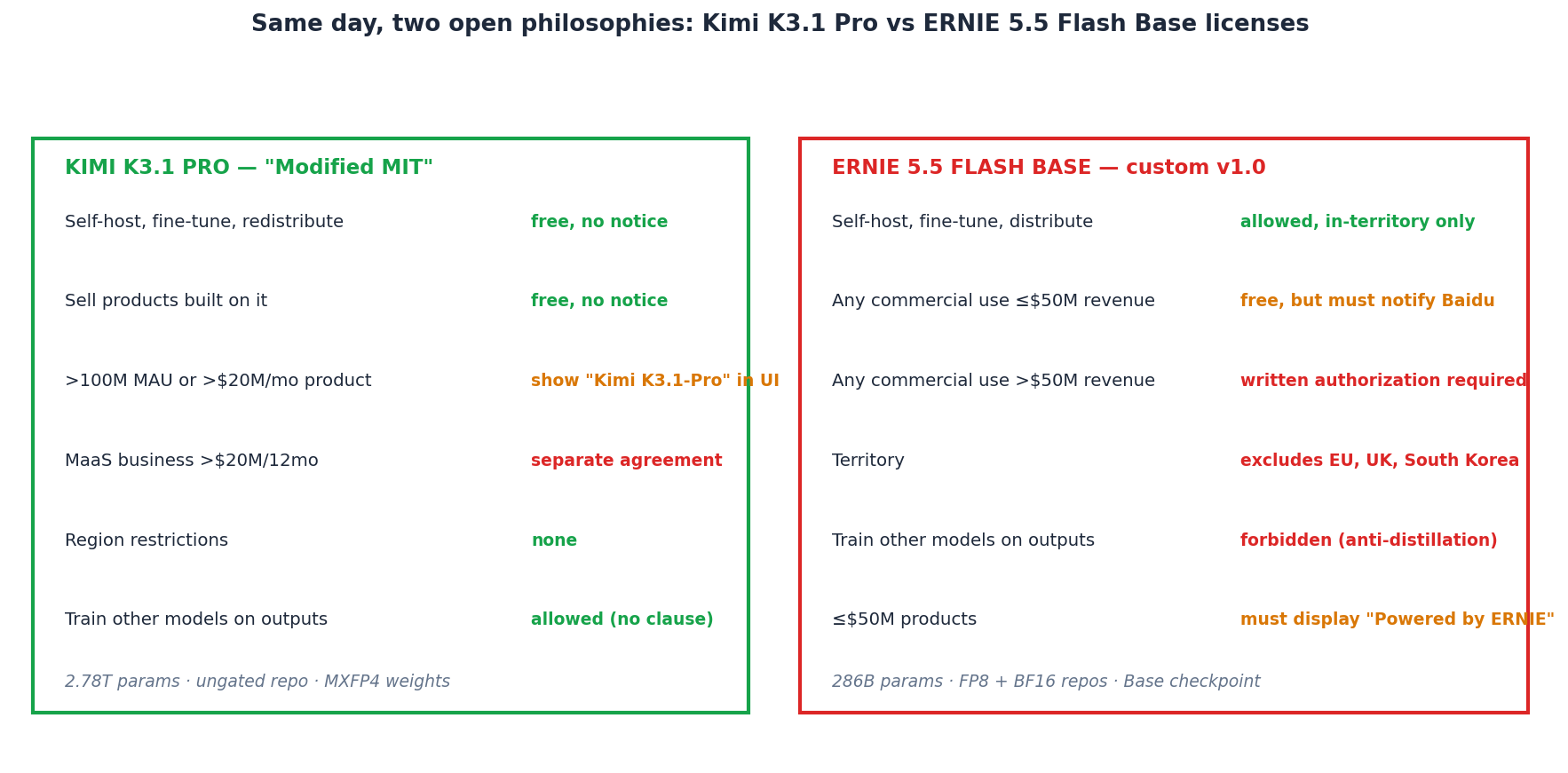
- The catch isn't the model — it's the license. We read the full v1.0 agreement: any commercial use above $50M in related revenue requires Baidu's written authorization; below that you're free but must email Baidu and display "Powered by ERNIE"; EU, UK and South Korea are excluded from the licensed territory entirely; and using its outputs to improve other models is forbidden.
- Contrast with Kimi's K3.1 Pro weights, which landed the same day on MIT-style terms. If you're picking an open Chinese base model for a product you intend to commercialize, the license gap between these two releases is wider than any benchmark gap between them.
What you're downloading
ERNIE 5.5 Flash Base is the pretraining-endpoint model — think of it as Baidu's equivalent of an Llama-style base checkpoint. The specs, cross-checked against the official model card and our own repo pull: 286,245,697,882 parameters (Baidu rounds to 280B, 14B activated per token via MoE routing), FP8 safetensors with a BF16 twin repo, and a context length of 128K at training time, extendable to 1M through fine-tuning and inference. It ships in both FP8 and BF16, which is a friendlier touch than most — no quantization archaeology needed.
On benchmarks, Baidu's claim is "same-size SOTA": the model card's comparison chart puts it ahead of DeepSeek-V4-Flash-Base, GLM-6-Air-Base and Qwen3.5-32B on Chinese, English, and reasoning suites at the ~300B-MoE class. We haven't reproduced those runs; base-model benchmarks are also the least predictive of end-task quality — what you do in post-training dominates.
The license is the story
Forget Apache-2.0 comparisons. The "ERNIE 5.5 Flash Base Model License Agreement v1.0" is a custom commercial license with real teeth:
- Revenue wall at $50M. Above that line — measured across all your products and services related to or derived from the model — you need written authorization from Baidu. Below it, you're licensed, but you must send a one-time notice to Baidu and display "Powered by ERNIE" in your product. Note the difference from Kimi's terms: Moonshot's $20M trigger applies only to reselling model access (MaaS); Baidu's $50M wall applies to essentially any commercial use touching the model.
- Geography wall. The licensed territory excludes the EU, the UK, and South Korea — and clause 5.3 doesn't just restrict use of the weights there; it restricts making the outputs available in those territories. A deployment that serves European users from a Hong Kong server is still outside the license.
- Distillation wall. Using ERNIE's outputs to improve any other model is expressly forbidden — the same clause class Llama uses, and the one that matters if your pipeline involves synthetic data generation.
- Also present: a patent retaliation clause (suing Baidu over patents terminates your license), operator liability for downstream users' compliance, and Hong Kong law with exclusive HK jurisdiction.
None of this makes it a bad model. It makes it a strategic choice: fine for research, evaluation, and China-market products under $50M; hostile territory for a European startup or anyone building on top of multiple frontier models with shared infrastructure.
Verdict
As a piece of pretraining, ERNIE 5.5 Flash Base at 280B/14B active is a credible entry in the open-weights middleweight class — and the FP8+BF16 dual release is genuinely developer-friendly. But read the license before you invest a post-training cycle in it. The moment your product works, you're negotiating with Baidu, displaying their brand, and geo-fencing three markets. Kimi's K3.1 Pro release from the same 48 hours shows what the alternative philosophy looks like. We know which one we'd build on.
Verified first-hand on 2026-11-05: repo metadata (286,245,697,882 params, FP8/BF16 repos, ungated) and the complete License Agreement v1.0 text (release date Nov 5, 2026) via the Hugging Face API; model card specs (14B active, 33.5T training tokens, 128K/1M context, benchmark comparison chart) as published by Baidu. Benchmark superiority claims are vendor-reported and not reproduced by us.
Sources: baidu/ERNIE-5.5-Flash-Base repo, model card and LICENSE (checked 2026-11-05), Tencent News — Baidu open-sources ERNIE 5.5 Flash Base, PANews — same-day open releases context