AI news
ERNIE 5.5 Flash Preview: one model, four price tags
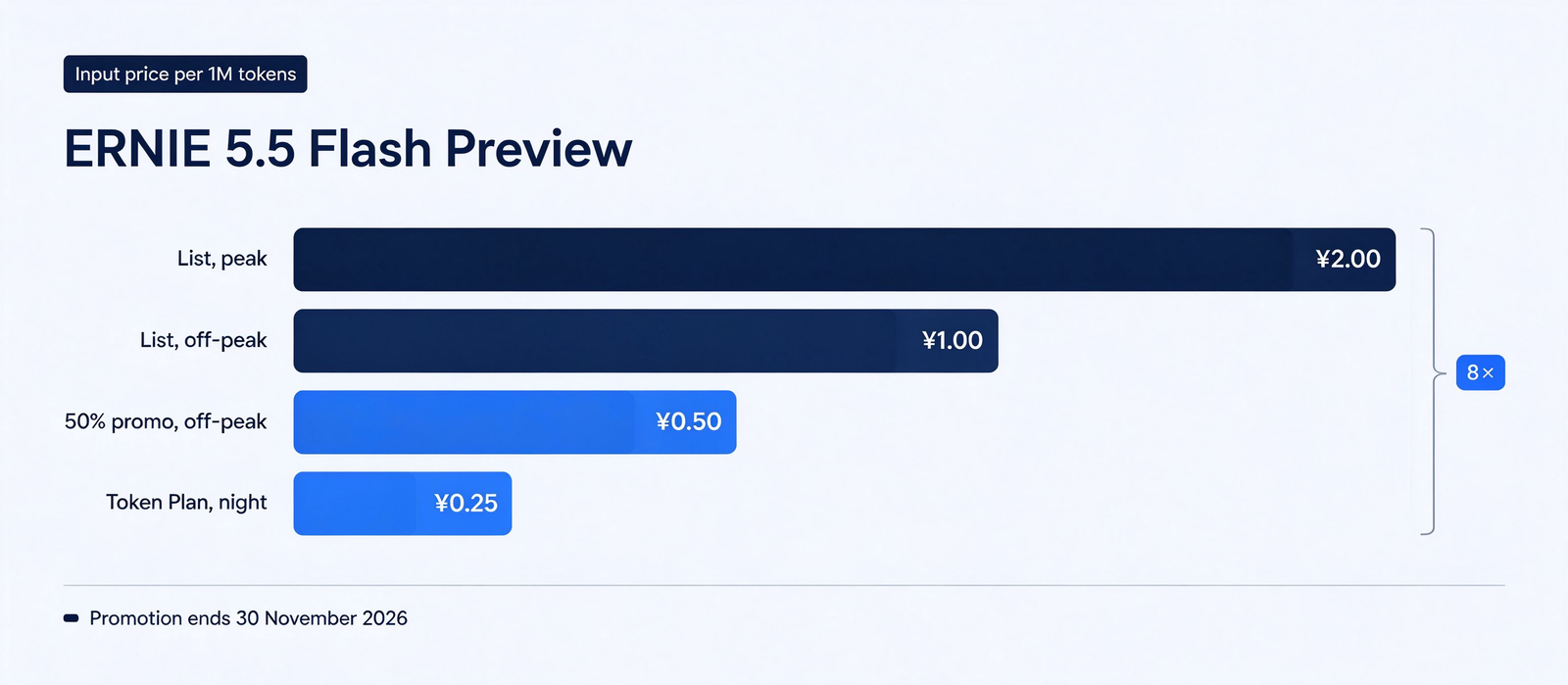
Baidu released ERNIE 5.5 Flash Preview on 11 November 2026 — 280B total parameters, 14B active per token, a 1M-token context window, and a price sheet with no single number in it. The same million input tokens cost ¥2 or ¥0.25 depending on which ledger you read, and both are official. Here is the ladder, the arithmetic, and the date it moves.
Four ledgers, one token
Baidu prices by time of day, applies a launch discount, then layers a subscription discount on top:
| Ledger | Input, ¥ per 1M | Cached input, ¥ per 1M | Output, ¥ per 1M |
|---|---|---|---|
| List price, peak hours | 2.00 | 0.20 | 8.00 |
| List price, off-peak hours | 1.00 | 0.10 | 4.00 |
| Promotion (50% off), peak | 1.00 | 0.10 | 4.00 |
| Promotion (50% off), off-peak | 0.50 | 0.05 | 2.00 |
| Token Plan subscriber, daytime | 1.00 | 0.10 | 4.00 |
| Token Plan subscriber, night | 0.25 | 0.025 | 1.00 |
Every tier keeps the same internal ratios: cached input is one tenth of fresh input, output is four times input. The time-of-day, promotion and subscription steps scale the whole invoice, not individual cells.
The 8× is three halvings stacked
Peak hours double everything: ¥2 against ¥1, ¥8 against ¥4, ¥0.20 against ¥0.10. The launch promotion halves that. The subscriber night rate halves the already-halved off-peak figure, a 2.5折 step that Baidu calls 25% of list.
- What any account can reach: 2× time-of-day × 2× promotion = 4×, i.e. list peak at ¥2 versus promotional off-peak at ¥0.50.
- What a Token Plan subscriber can reach at night: another 2×, so 8×, ¥2 versus ¥0.25 — 87.5% off the dearest published figure.
- Cache changes the input line, not the spread. At a 90% hit rate the blended input cost is 0.9 × ¥0.20 + 0.1 × ¥2.00 = ¥0.38 per 1M at list peak, an 81% cut on input — but the same 81% at every tier, so the 8× survives.
One caveat on the stacking: the subscriber's daytime 50% and the launch 50% are announced separately, and Baidu does not say whether the first sits on top of the second. Both land on ¥1, so the table stands either way.
What a 20-turn agent task actually bills
Per-task cost is what you pay, not token price. Take a modest coding-agent pattern: an 8K system-and-tools prompt reused each turn, 20 turns, 300 output tokens per turn — 8,000 fresh input, 152,000 cached input, 6,000 output.
| Tier | Cost per task | 10,000 tasks |
|---|---|---|
| List price, peak | ¥0.094 | ¥944 |
| List price, off-peak | ¥0.047 | ¥472 |
| Promotion, peak | ¥0.047 | ¥472 |
| Promotion, off-peak | ¥0.024 | ¥236 |
| Token Plan, night | ¥0.012 | ¥118 |
Note the overlap: promotional peak and list off-peak both come out at ¥0.047, to the tenth of a fen. If you cannot move work into the night and will not take Token Plan, the promotion buys exactly the price a schedule shift gives you after 1 December — a test window more than a discount.
The December 1 cliff
The promotion runs from 11 November to 30 November. On 1 December, with no schedule change and no subscription, the same task goes from ¥0.024 back to ¥0.094 at peak — nearly quadruple, overnight. This is the pattern flagged for Gemini 4 Argon: a 50%-off launch rate is a schedule, not a price. Budget against the list column and treat the discount as headroom.
The model behind the price
The price is tied to an architecture built for per-token cost. ERNIE 5.5 Flash Base — open-weighted on 5 November — runs 43 layers, 37 of them compressing every 128 tokens into one cache entry, leaving 6 full-fidelity layers with sparse retrieval for exact recall. Each MoE layer holds 512 experts and activates 10 plus one shared, which is how 280B becomes 14B per token; ECHO reuses the final layer to draft tokens ahead for speculative decoding.
Baidu reports over 200 output tokens per second and calls the preview an intermediate post-training checkpoint: weights land 25 November, and the vendor itself warns some gaps may come from unfinished training. A preview with a rate card and a weights date is testable; a preview its own maker flags is not a drop-in for production.
What is still a vendor claim
- 14 of 20 benchmarks beat DeepSeek-V4.1-Flash-1017, MCP-Atlas first, BrowseComp and DRACO second behind Hunyuan Hy4 — vendor-reported, some self-tested, no independent harness.
- Terminal-Bench 4.0 at 46.5, AutomationBench at 61.9, SpreadsheetBench V2 at 36.4 — same caveat: vendor numbers.
- "Half of DeepSeek's price." I could not open a first-party DeepSeek tariff in this session to check it, so treat it as a comparison drawn by the vendor's own chart, not a measured fact.
- No context-length tiers in the published table. One price per token whether you send 10K or 1M. That is what has been published; a long-context surcharge appearing later would not be the first time.
What I would do this week
If your workload tolerates off-peak scheduling, run it inside the promotion and measure your real cache hit rate before 30 November. The ¥0.05 cached input assumes prompts actually repeat; at a 50% hit rate the blended input at promotional off-peak is 0.5 × ¥0.05 + 0.5 × ¥0.50 = ¥0.275 per 1M — cheap, but the "one tenth" headline no longer applies.
If your traffic is interactive and daytime-bound, the honest pair is ¥1 input and ¥4 output until 30 November, then ¥2 and ¥8. Budget on that, not on the ¥0.25 in press coverage, which needs a Token Plan subscription and a night shift.
Sources: Baidu's 11 November 2026 launch figures — 280B total / 14B active parameters, 1M-token context, over 200 output tokens per second, list prices ¥2 / ¥0.2 / ¥8 per 1M (peak) and ¥1 / ¥0.1 / ¥4 (off-peak), 50% promotion from 11 to 30 November, weights on 25 November — reported by Sina Finance and by Zhi Dongxi, cross-checked between the two (checked 2026-11-11); Token Plan stacking of 50% daytime and a further 50% at night (2.5折), announced at Baidu World 2026 on 12 November (checked 2026-11-12); ERNIE 5.5 Flash Base architecture — 43 layers, 37 compressed-attention layers, 512 experts activating 10 plus one shared, ECHO, R2L tokenizer, 33.5T pretraining tokens — Baidu release blog and technical write-up (checked 2026-11-12); benchmark figures as published by Baidu, relayed by Zhi Dongxi (checked 2026-11-12). Note: Baidu's own Qianfan billing documentation blocks automated reads, so the tariff above is Baidu's briefing as relayed by two independent outlets rather than a public rate card.