DeepSeek
DeepSeek dsh-superagent: A Seed, Not the Plant — What the MIT Prototype Really Contains
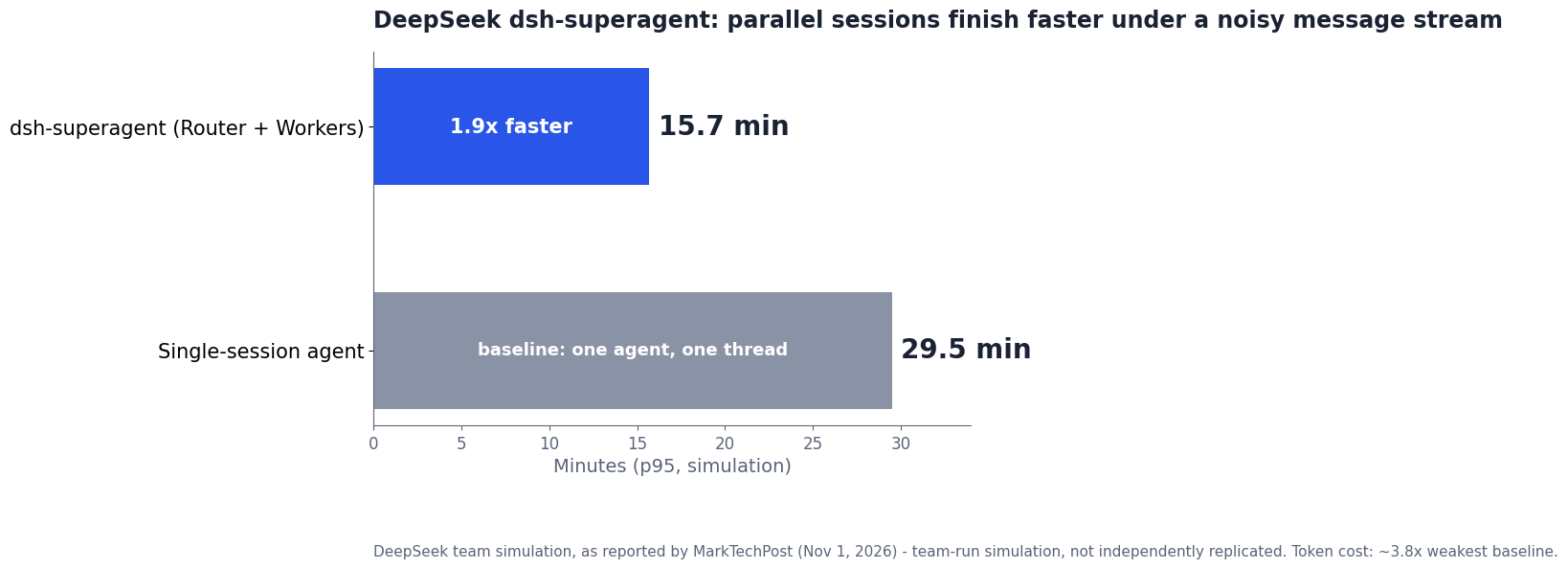
Verdict: DeepSeek's Harness team open-sourced dsh-superagent-prototype on October 31 under MIT — a proactive coding agent that watches one GitHub repository (plus Feishu, optionally) and turns allowed requests into work items, each handled in its own agent session. Two days in, the repo has 8,000+ stars and a handful of English write-ups. My take after reading the code and docs: what's open-sourced is a seed, not the plant. The README says so itself — the published code was "adapted for publication," is "not identical to our internal version," and some designs from the companion paper are "not implemented in this prototype." That honesty is exactly why this release is worth your time: the eight numbered docs are a masterclass in team-agent design (observe-by-default authorization, a strict domain model, auto-merge capped at 200 changed lines), and you can steal the ideas without running a line. If you want to run it: it targets exactly one repository, requires DeepSeek Harness, and in DeepSeek's own simulation burned roughly 3.8× the tokens of the weakest baseline to finish tasks ~1.9× faster under a noisy message stream. That trade only makes sense for high-value repos.
DeepSeek announced dsh-superagent on WeChat on , alongside a design article, Exploring Super-agent Design: Towards a More Autonomous Agent System. The core argument of that article, as reported by Chinese tech media: what limits multi-session agents today is not the model — it is the bandwidth of the human supervising three to five parallel sessions. The prototype is the team's answer: an agent that acts for a team, but "take[s] as little human attention as possible, and give[s] as much value as possible."
What the prototype actually is — verified against the repo
The GitHub repo (deepseek-ai/dsh-superagent-prototype, created October 31, 2026, MIT license) describes a TypeScript bundle for DeepSeek Harness, DeepSeek's agent runtime. The scope is deliberately narrow:
- One GitHub repository per deployment. Not a workspace, not an organization — a single repo, with GitHub (and optionally Feishu) as event sources.
- Work items, not chat. An allowed request opens a Ticket; the agent works it in its own session and directory; results return to the original conversation — typically a pull request.
- A web panel that shows only what needs a person. Everything the agent decided on its own stays folded away.
- The domain model is strict. Source → Trigger → Thread → Eval → Ticket (with a Mandate) → Assignment → Executor → Channel. Concepts have explicit rules — a restart must not replay events, accepting a Trigger twice creates one Ticket (idempotence), and at most one Eval runs per Thread at a time. This is real systems design, not a demo.
The README is unusually honest — read it before the hype
Three admissions sit at the top of the README, and each one matters for how you should use this release:
- "Research prototype for reference only, not an official DeepSeek product." The team adds that much of the engineering was done by coding agents, and the code "may still contain bugs." Expect research-grade consistency.
- "Not identical to our internal version." What DeepSeek runs internally — and what the design article describes — is not what you can clone. Several designs in the article are labeled "directions for future development."
- The benchmark numbers come from simulation — synthetic messages and simulated tools, not real repositories under real team traffic.
The design ideas worth stealing (even if you never run it)
The durable value here is the authorization and execution discipline, which you can verify in the docs:
- Observe by default. Out of the box, unprompted work is only written down, never executed. Proactive acceptance requires auto mode and an explicit team-written matching rule with evidence of intent — outside auto mode, an inferred accept becomes a "would accept" record (
docs/007,admitsInferred). - Auto-merge is engineered to be boring. The Executor never merges as the agent account by default (GitHub attributes the merge to whoever enabled it), and default instructions allow auto-merge only for the Ticket's own pull request, with required approvals, and fewer than 200 changed lines. Push another revision and auto-merge is withdrawn (
docs/003). - Attention is the scarcest resource. The whole domain model is built so the agent speaks only when someone must act or can use a result — the panel surfaces exceptions, not activity.
The numbers, with sources
DeepSeek's simulation (reported by MarkTechPost, Nov 1): p95 task completion of 15.7 minutes vs 29.5 minutes for a single-session baseline under a noisy message stream — about 1.9× faster. The token bill, per the design article as reported by Chinese media (Machine Mind / Tech verbosity reprints, Nov 2): roughly 3.8× the weakest baseline. Both figures are the vendor's own, on simulated inputs — treat them as directional. GitHub traction is real though: 8,000+ stars within ~48 hours, and the repo was a single commit at release.
Should you run it?
Run it if you maintain one high-value open-source repo with a steady stream of issues and PRs, you already run DeepSeek Harness, and you have appetite for supervising a semi-autonomous contributor. The SETUP.md flow is agent-driven: you ask your coding agent to read it, answer a few questions, and it installs. Skip it if you expect a product — this is research code with an MIT sticker, scoped to one repo, and the interesting parts of the design article are explicitly not implemented. Read it regardless if you build any agent system: the eight numbered docs (philosophy → domain → authorization → execution → prompts → panel → deployment → architecture → cookbook) are the clearest published thinking on team-facing agent discipline I've seen from any lab this year, and they cost nothing to borrow.
One more thing worth noting: this is the second high-signal open-source drop from the Harness ecosystem in two weeks (after the Search & Fetch APIs started billing on November 1 — see our billing breakdown). DeepSeek is visibly building an agent platform in public, not just shipping models.
against primary sources: GitHub repo deepseek-ai/dsh-superagent-prototype (creation date, MIT license, star count, README text, docs/001-domain.md, docs/003-execution.md, docs/007-architecture.md). Reported (transcribed): simulation figures (p95 15.7 vs 29.5 minutes) per MarkTechPost, Nov 1, 2026; token-consumption ≈3.8× weakest baseline and the design-article framing per Chinese tech media reprints (机器之心/科技干货铺, Nov 2, 2026) — the design article itself is not independently accessible to this writer.
Caveat (dated 2026-11-02): Star counts and the benchmark numbers change; the prototype is explicitly not the internal implementation. Accuracy is as of publication date.
Related reading: DeepSeek Search & Fetch billing math, DeepSeek V4.1-Flash-1017 release notes, Clover-35B diffusion LLM for agents, Kimi K3.1 Pro vs GPT-6 Astra pricing.